

- Published by:
- Environment Protection Authority
- Date:
- 3 July 2026
Victoria’s climate is changing. In recent decades Victoria has become hotter and drier during the cool season. It has experienced more extreme weather events. These changes are expected to continue under a warming climate.
A climate hazard is a climate-related event or condition that has the potential to cause harm. Climate hazards that affect Victoria include floods, heatwaves, drought, bushfires and sea-level rise.
In this guidance, physical climate risks are defined as the risks from pollution and waste on people and the environment that arise from the physical impact of climate change.
When infrastructure, operations, or systems are exposed to climate hazards, problems can increase. Existing risks may become worse or new risks may appear. These risks from pollution and waste can harm people’s health or the environment.
Examples of physical climate risks are:
- increased bushfire weather and fire activity could increase fire risk at your facility. This could increase the risk of harm to nearby communities
- increased dry periods could increase dust emissions from your facility. This could increase the risk of harm to people and surface waters nearby
- more extreme weather events (such as bushfires and floods) could result in loss of power or damaged infrastructure. This could lead to increased harmful emissions escaping to the environment
- more storm events could increase the risk of contaminated stormwater runoff. This could lead to pollution of nearby surface waters and land
- sea-level rise can lead to flooding and increased risk of pollution to surface waters.
The Environment Protection Act 2017 (the Act) requires people to take responsibility for their actions. If an activity could cause a risk of harm, those risks must be minimised so far as reasonably practicable. ‘Risk of harm’ means to human health or the environment from pollution or waste. This is the general environmental duty (GED).
Importantly, the GED does not just require that the physical risk of harm to human health or the environment be minimised. Non-physical risks of harm from pollution or waste, must also be reduced so far as reasonably practicable. For example, risks to Traditional Owner cultural values and psychological health.
This guidance will help you:
- assess and minimise your physical climate risks
- meet your GED
- with information on recent Victorian climate science
- with examples of controls you may use for minimising pollution and waste risks in a changing climate.
Greenhouse gas (GHG) emissions contribute to climate change. This guidance does not relate to GHG emissions. Learn more about how to minimise GHG emissions from your business.
Your approach to assessing and managing risk will depend on the nature and scale of your activities and how complex they are. It also depends on the location of the activity and kinds of risks from climate change you need to manage.
Climate change is likely to increase or create new risks of harm from businesses. This is particularly for those engaging in medium to high-risk activities. The greater the risk of harm, the greater the expectation for you to eliminate or reduce the risks, so far as reasonably practicable
There are other relevant duties in the Act relating to pollution and waste that you must follow.
Audience
This guidance is for Victorian businesses that carry out medium to high-risk activities. Regardless of whether they hold an EPA permission.
Medium to high-risk activities in this guidance are:
- activities that have a medium to high potential to cause harm under current climatic conditions
- sites located in climate-vulnerable areas like floodplains, coastal zones or bushfire prone regions
- existing activities where climate change has already increased or caused pollution or waste
- any of the following activities:
- outdoor storage and handling of liquids and solid materials. Outdoor activities are more exposed to climate hazards
- outdoor storage and treatment of waste
- storage and treatment of wastewater
- activities that could generate offsite pollution or waste from:
- outdoor plant
- equipment
- pipework
- underground storage of chemicals
- indoor activities that could cause harmful gases or particles to escape outside into the air (e.g. damage to buildings and structures)
Some activities need a permission from us. To find out what you need, go to climate change requirements.
The guidance helps in the design of new developments and operation of existing activities. It does not include construction activities, given their temporary nature. See our guidance for the construction industry.
You may have already identified climate hazards that may cause new risks through your risk management process.
Some business activities pose a low risk of harm. For example, they may generate small amounts of waste that can go in normal bins. Examples include retail stores, offices and cafes.
If your business activities are low-risk, go to Appendix A - How to consider climate change if your business activities are low-risk.
For the remainder of this guidance, when we refer to ‘activity’ we mean any medium to high-risk activity.
Victoria’s changing climate
Victoria’s Climate Science Report 2024 (VCSR24) has the best available scientific evidence on Victoria’s climate. Highlights include:
- Under a high emissions scenario Victoria is expected to experience average warming of 1.5 °C by 2050 and 3.1 °C by 2090. This is compared to the period between 1986-2005.
- Under a low emissions scenario Victoria is expected to warm by 1.1°C by 2050, with little further warming. This is compared to 1986 to 2005.
- Climate hazards are also changing. These are projected to be exacerbated under a warming climate.
In the VCSR24, The Victorian Government recognises climate change disproportionately impacts Aboriginal communities. Climate change compounds the loss of traditional connections to Country. It poses a risk to cultural heritage, including traditional laws, customs and practices. Climate change impacts on Country include:
- sea-level rise
- the presence or absence of water
- changes in plant and animal behaviour
- increased intensity and frequency of bushfires and extreme weather events (VCSR24).
Risk management approach
Following a risk management process will help you manage risks of harm from your activities. Your approach should include a focus on risk of harm from pollution and waste.
We recommend incorporating physical climate risks into your existing risk management framework. This can:
- help consider physical climate risks in the context of other risks
- support identification of common controls for minimising risk of harm
- help prioritise the implementation of controls
- ensure you check controls for physical climate risks as part of your routine risk management process.
The steps to control the hazards and risks in a changing climate are:
- identify current and future climate hazards and how they can cause or increase harms from your activities
- assess the physical climate risks that may arise from exposure to climate hazards
- put controls in place to eliminate or reduce the physical climate risk
- review controls regularly. This will ensure they are effective in a changing climate.
This risk management approach aligns with:
Assessment
The level of detail of your assessment of physical climate risks should be proportionate to the:
- nature, scale, location and complexity of your operations
- risk that climate change creates for your activities.
Be aware your approach may change over time as state of knowledge develops. This includes changes to your physical climate risk exposure.
Qualitative assessment
This guidance sets out a qualitative approach to assessing physical climate risks. It is consistent with Assessing and controlling risk: A guide for business.
The approach may be useful:
- for medium risk activities
- as an initial screen for larger businesses or those that pose a high level of risk of harm. The qualitative assessment may help determine the need for more detailed assessments.
Detailed assessment
More detailed assessments are more comprehensive and semi-quantitative or quantitative in nature. A more detailed assessment is likely to be needed for some situations, such as:
- high level of risk of harm. For example, the overall level of risk to human health or the environment is high
- critical systems. For example, if the consequences of system failure are severe
- assets that are at risk of causing pollution or waste and are rarely replaced. For example, a wastewater treatment plant, sewage pump station or landfill
- decisions where a higher degree of precision is needed. For example, engineering design
- sites located in climate-vulnerable areas like, floodplains, coastal zones or bushfire prone regions.
See the Additional resources section below for further information about more detailed assessments.
Other assessments and documentation
You may already be assessing how climate change may increase risks from your activities. It may be part of your:
- mandatory climate related financial disclosure (CRFD) obligations. This is if your business meets sustainability reporting thresholds.
- environmental management system, plans and supporting documentation
- corporate risk management process
- emergency risk management process including for critical infrastructure.
Including risks of harm in these assessments can help you meet your GED obligations. For example:
- your corporate risk management process may be more focused on service disruptions or property damage. Include risks of harm in your assessment.
- your existing management systems, plans and procedures may already include climate risk. These documents may be enough to show how you are meeting your GED obligations. This guidance can help you assess whether there are any gaps.
Consider physical climate risks when undertaking a detailed risk assessment of key environmental aspects/ environmental segments.
Risk management and monitoring program
Certain EPA permission holders need a site-specific risk management and monitoring program (RMMP). You should document how you have considered physical climate risks as part of your RMMP.
Additional resources
Other sources of information may help you consider physical climate risk:
- Industry associations or similar international operations facing different or more extreme weather
- National Climate Risk Assessment
- Climate Risk and Opportunity Management Program resources
- Guidelines for the Adaptive Management of Wastewater Systems Under Climate Change in Victoria. This contains information on detailed assessments for wastewater systems.
- Built Environment Climate Change Adaptation Action Plan
- Local government climate adaptation plans.
- Other government authorities such as the UK Government Environment Agency industry sector examples. Note: climate change projections for the UK are likely to be different to Australia. However, some impacts and example controls may still be relevant.
You can choose to assess the physical climate risks. You can also get help from a suitably qualified and experienced consultant.
Identify current and future climate hazards and how they can cause or increase harm from your activities
Climate hazards can be:
- acute (e.g. the sudden onset of extreme weather)
- chronic (e.g. long-term changes that occur over years or decades).
Acute climate hazards
- Heatwaves and extreme heat
- Bushfires
- Extreme rainfall
- Storm events
- Floods.
Chronic climate hazards
- Temperature rise
- Annual rainfall changes
- Drought (can also be acute)
- Sea-level rise.
This section will help you identify:
- existing and future climate hazards
- how climate hazards can cause or increase harm from your activities.
Identify current climate hazards and potential harm from your activities
The effects of climate change differ across Victoria. Some areas are at a higher risk from flood, bushfire or sea-level rise.
Your site location and geographical area may be vulnerable to climate hazards now. This may be, because it:
- is in or near an area prone to bushfires or floods
- is in a coastal or low-lying area
- has experienced previous extreme weather events.
To help you identify which climate hazards may affect your area, see below.
Victorian sources:
- Local Traditional Owners. Their knowledge and expertise can help respond to the challenges of climate change. Sources include Country Plans and local council Reconciliation Action Plans.
- your council
- Victoria State Emergency Service for Local Flood Guides, flood history and planning for emergencies at work
- VicPlan for areas subject or likely to be subject to bushfires or inundation
- Victoria’s changing climate resources. This includes:
- Victoria’s Climate Science Reports: VCSR24 and VCSR19
- regional summaries for future climate change
- Bushfire Management Strategies for regional bushfire history
- Catchment Management Authorities
- Emergency Management Victoria resources. This includes:
- State Emergency Management Plan and Sub-Plans, including for some climate hazards
- Emergency Risks in Victoria. The report identifies Victoria’s highest priority emergency risks. It includes some climate hazards
- Regional Emergency Management Plans and Municipal Emergency Management Plans. These consider region specific and local and municipal risks, including climate hazards
National sources:
- Bureau of Meteorology (regional past meteorological records and special climate statements)
- Insurance Council of Australia (catastrophe resilience reports and datahub referencing extreme weather events)
- Australian Disaster Resilience Knowledge Hub (repository of historical disasters)
How may current climate hazards cause or increase harm from new developments and existing activities? To understand how, map out:
- changes to sources of pollution and waste
- exposure pathways
- exposure receptors.
A conceptual site model can help.
For each relevant climate hazard, ask how it impacts different activities:
- how might [climate hazard] impact various infrastructure/ assets?
- how might [climate hazard] impact the storage of materials (raw, bulk, hazardous, liquids)?
- how might [climate hazard] lead to process upsets? (e.g., break downs or failure of environmental controls)
- how might [climate hazard] impact your site stormwater system and storage or discharge of liquid process wastes?
- how might [climate hazard] impact your emissions and discharges?
- how might [climate hazard] generate more waste streams?
Identified current climate hazards already causing harm from your activities
Climate change may have already caused or increased harm from your activities.
To determine this, review:
- incident records or insurance claims
- environmental complaint records
- maintenance logs
- emergency response records
- any long-term monitoring related to your site.
You can also ask long-standing employees if and how climate hazards have affected your business over the years.
What if these types of events were to become more frequent, extreme or last longer? What extra controls might be needed?
Identify future climate hazards and potential harm from your activities
A key step in assessing physical climate risks is to consult climate change projections.
The information you use should allow you to undertake a qualitative risk assessment. This can help inform you about how to eliminate or reduce the risk to an acceptable level.
To understand how future climate may impact new developments and existing activities, choose both:
- emission scenarios
- time horizons.
Emissions scenarios
This guidance adopts emissions scenario framing. This framing describes the projected change under an emissions scenario for a certain time horizon. We used it because it aligns with the format used in VCSR24 emissions scenario framing (explained in section 3.1). It is also familiar to most decision makers who rely on climate projections.
Other frameworks exist to communicate climate projections, such as global warming levels (GWLs). The GWLs framework describes the expected change that will be experienced across the world. This will be felt when a specific level of average warming is reached across the globe. Such as, when average global temperatures reach 2 °C.
The climate we experienced in the past is no longer a good predictor of future climate. Instead, a range of possible emissions scenarios are run through models to explore possible futures.
Emissions scenarios are based on different amounts of GHG emissions in the atmosphere. They are ‘plausible futures’ not predictions.
Whether you are undertaking a qualitative or more detailed assessment:
- choose at least 2 scenarios to understand the range of plausible outcomes. This helps to deal with some uncertainties from climate change
- select medium and high emission scenarios. Selecting a high emissions scenario can account for the potential worst-case consequences. Low emissions scenarios are unlikely to provide the full breadth of physical climate risks that may be experienced
- use emissions scenarios based on internationally recognised climate models and emissions scenarios
- differences in emissions scenarios are generally small up to 2030 before they start to diverge. Thus, one scenario may be adequate to assess risks for short-lived assets
- use the full name of the emissions scenario you are using (e.g. SSP3-7.0 or RCP8.5). This is because the description of scenarios can change over time (e.g. low, medium, high or very high). This is because climate science is evolving.
The Victorian Government has a range of low, medium and high emission scenarios in Victoria’s climate projections.
- VCSR19: Representative Concentration Pathways (RCPs):
- RCP4.5 (medium)
- RCP8.5 (very high)
- VCSR24: Shared Socio-economic Pathways (SSPs):
- SSP3-7.0 (high)
- SSP1-2.6 (low)
- Regional summaries – explain the climate projections for different regions of Victoria
- Victoria’s Future Climate Tool – an interactive portal. It allows direct access and exploration of these climate projections across Victoria.
VCSR24 projections add to projections in VCSR19. They do not replace them. Here’s more information on how VCSR24 and VCSR19 projections compare.
Using scenarios related to your CRFD obligations
You may already be undertaking climate-related scenario analysis if you have CRFD obligations. You may be able to use some of the same scenarios if they help you assess your physical climate risks related to risk of harm. This includes medium and high emission scenarios.
Note: CRFD scenarios consistent with an increase in global average temperature of 1.5 °C above pre-industrial levels are low emission scenarios. You should not use these to conduct scenario analysis under this guidance.
Time horizons
To understand how much the climate will change in the future, climate modellers compare future climate to past climate. Time horizons (a future time-period) are compared with an historic baseline (a past time-period). This allows the calculation of the amount of change in climate variables over a given period.
Common baseline periods used by climate researchers are 1986 to 2005 and 1995 to 2014. These are used in the Intergovernmental Panel on Climate Change’s Fifth and Sixth assessment reports, as well as VCSR19 and VCSR24.
Common future time horizons include 2030, 2050, 2070 and 2090. They model a 20-year period. A 2050 time period represents the climate for 2040 to 2059.
It is generally recommended to select at least 2 time horizons to inform the change in risk over time.
However, this depends on the activity or the expected life of the asset:
- a short-lived asset with a 5-10 year operation or less may look at a 2030 horizon
- a medium-lived asset with a 20-year operation may look at 2030 and 2050 horizons
- an asset with a 100-year expected life may assess physical climate risk using 2050 and 2090 horizons.
Sometimes projections do not exist beyond the expected life of the asset. In this case, the longest projections available should be used.
Choose appropriate emissions scenarios and time horizons to suit your needs and circumstances. Justify your choices in your risk assessment.
Exploring climate change projections for selected timeframes and emission scenarios
How is a given climate variable (e.g. temperature) projected to change (decrease, increase, no change) during the selected time scale (e.g. near to mid-term, long-term) for the medium/high emission scenario?
Sources of information to understand future climate change include:
- VCSR24 and VCSR19
- regional summaries
- technical reports and factsheets
- Victoria’s Future Climate Tool
- CSIRO Climate Change in Australia Projection data, for example, Summary data explorer. This data may contain more climate parameters. This data is not as high resolution as the Victorian datasets in VCSR19 and VCSR24 and Victoria’s Future Climate Tool.
- Guidelines for Assessing the Impact of Climate Change on Water Availability in Victoria.
The VCSR19 and VCSR24 and regional summaries may be all you need if you are undertaking a qualitative assessment. Victoria’s Future Climate Tool may be more useful when you are doing a more detailed quantitative analysis.
Here’s more information for decision-makers with different needs.
You can use the resources listed above to help you consider potential changes to hazards from your activities.
Consider normal and abnormal operations, as well as:
- cascading impacts where extreme weather events in one sector can have flow-on effects to others. Things like an extreme weather event may cause a loss of power, which may lead to a shutdown of process cooling. This can lead to a fire, explosion, infrastructure damage or chemical release.
- compounding impacts where extreme weather events happen at the same time or close together. This can produce combined impacts that are worse than the individual events. Such as:
- fires and floods happening in quick succession
- heatwaves, drought and bushfires can interact and happen at the same time (VCSR24 p77).
Projections indicate that Victoria’s climate will change. However, it is not possible to determine the exact impacts of climate change at any location or time with complete certainty.
Uncertainty should not be a barrier to taking action to minimise the risks of harm arising from physical climate risks. This is consistent with the precautionary principle under the Act. Using a risk assessment approach helps to deal with some uncertainties associated with climate change.
Chapter 3 and 5 of VCSR24 provides more information on uncertainties associated with future climate change.
Assess physical climate risks
Now that you have identified current and future climate hazards and how they can cause or increase harm from your activities, it’s time to assess.
This step is about assessing the physical climate risk of harm. First, you need to consider how severe that harm could be and how likely it is to happen.
Assessing likelihood and consequence
Assess how the climate hazard may change the likelihood and consequences of harm. You should assess this under each emission scenario and time horizon. See Appendix B which is a template showing how to assess your pollution or waste under future emission scenarios and time horizons.
Identify any risk management strategies you already have in place to minimise risks of harm related to climate hazards. This includes any emergency events. Then re-evaluate any residual risk. Residual risk is the level of risk or threat remaining after all applicable control measures have been implemented. This helps determine the efficiency of existing controls and if new or improved controls are needed.
When determining residual risk, ask yourself questions:
- has extreme weather caused specific equipment or processes to create more pollution or waste?
- have heatwaves or extreme heat days caused self-combustion of your stored waste? If so, what were the consequences of the fire? What existing controls do you have in place? Is there still any risk left that needs more controls?
Even if your system has not been impacted by climate hazards in the past, it may be in the future. More frequent, severe and longer-lasting climate hazards can increase the likelihood of harm to nearby receptors. Such as:
- increased bushfire weather and fire activity could increase fire risk at your site. This could increase the risk of harm to nearby communities. Especially for those that are more sensitive to smoke.
- heavier or more frequent extreme rainfall can increase the risk of uncontrolled site surface water and flash flooding. This could lead to increased harm to aquatic ecosystems in nearby surface waters.
Not all climate hazards are modelled in the regional projections. VCSR24 does not include storms, cascading or compounding impacts. These unmodelled climate hazards should also be considered. Refer to Factsheets under Download reports, regional summaries and supporting documents. They may have a low likelihood of occurring but can have high impact. Ask yourself questions:
- how effective will your controls be if climate hazards occurred close together (compound events)? Using the examples above, you may have waste from fires following a recent fire at your site. An extreme rainfall event may occur soon after the fire. If the waste from fires has not been properly disposed of it may be washed into the stormwater system and into nearby surface waters.
- how might failures in other systems impact your business (cascading impacts)? For example, floods and bushfires may cause transport disruptions to your site. This may cause you to have more stored waste on your site than usual. This could lead to increased risk of fire, odour and leachate leading to offsite harm.
- how might storms (including more extreme storms) damage and impact vulnerable infrastructure?
Consider also the vulnerability of the receiving environment. Ecosystems or communities that receive or are exposed to emissions or waste may be more vulnerable to climate change. River flows and volumes are likely to decrease due to climate change which can reduce dilution. This can lead to increased risk of harm to human health and the environment when discharges enter surface waters.
Controlling pollution and waste might be more difficult during severe weather. Some examples of this are:
- a fire might be more intense and harder to control during a heatwave or extreme heat
- a stormwater system may be harder to manage and not operate as effectively during intense storm events.
Our risk management process can help you assess the likelihood and consequences of your risks.
You can use your existing corporate risk criteria to evaluate risks from a changing climate.
Calculating the risk rating
Calculate an overall risk rating after assessing the likelihood and consequences of your risks. Do this for current (present-day) conditions and for each climate scenario.
Implement controls
As part of your GED obligations, risks of harm are to be minimised by implementing and maintaining appropriate risk controls. Controls should be monitored for effectiveness and continually improved.
Our risk management process includes a hierarchy of controls. Options for controlling risk are prioritised from the highest level of effectiveness to the lowest.
The risk control measures needed to meet your GED obligations depends on your specific circumstances. It is your responsibility to understand:
- your risks to human health and the environment from pollution and waste
- the right approach to minimise the risks, so far as reasonably practicable.
The risk control measures selected should seek to eliminate or otherwise reduce, so far as reasonably practicable, the overall risk of harm.
Some actions to reduce physical climate risks may also have other benefits like:
- installing renewable energy as backup power, reducing your GHG emissions
- investing in nature-based solutions to help provide flood and storm protection. This can also protect, manage or restore ecosystems.
The hierarchy of controls include:
- elimination: such as avoiding locating new developments in high-risk areas
- substitution: like replacing chemicals prone to thermal reactions with safer alternatives
- engineering controls: such as installing early warning systems including automatic alarms
- administrative controls: include emergency management plans, staff training and personal protective equipment.
Responding to physical climate risk doesn’t always mean major projects or investment. In many instances, greater accountability, planning and preparedness will help you address risks. By considering climate change in the activity design, it will likely save you money, in the long run.
Controls can often address several physical climate risks at once. Extreme weather events can cause power outages. Installing backup power can help keep critical infrastructure and control equipment operating.
Good examples of controls and measures are:
- design plant and infrastructure using the best available climate science. This is particularly relevant for new or upgraded developments
- maintain a system to manage assets. This can help assess existing assets for physical climate risks. It can help prioritise asset renewal, upgrades or replacement. Consider the best available climate science
- install and respond to early warning systems and automatic alarms
- install and inspect secondary containment infrastructure such as bunding
- inspect and maintain site and plant equipment on a regular basis
- update emergency management and incident management plans (as needed)
- train staff and build knowledge around climate hazards and response.
Examples of climate hazards, potential risks and common controls
This section provides a non-exhaustive list of examples. It includes climate hazards, potential risks and common controls. Consider your physical climate risks in selecting appropriate controls.
Prioritising controls
It is important to consider when you should implement risk controls.
If you are developing a new facility, infrastructure or asset, you should consider climate change in the design phase. It is recommended to integrate climate change scenarios into the design. This will help assess potential risks that may need more controls. It will allow the most effective controls to be considered first. This also applies to upgrades.
Risks rated high or extreme in your assessment may need immediate action. This might be due to the immediacy of the risk or the degree of harm that could occur.
Sometimes the timing of the impact is uncertain, or the most effective control is not possible in the short-term. In these situations, an adaptation pathway approach can be used. This approach supports flexibility in decision-making. It helps identify which decisions to make now and in the future. This allows some flexibility as state of knowledge changes.
An adaptation pathway approach provides a roadmap over the long-term and can be documented in an adaptation action plan. It allows implementation of a range of reasonably practicable controls over time. Controls do not need to be mutually exclusive.
Trigger points can be set to signal when decisions should be made. Triggers should be set so there is enough time for planning. This includes assessment and decisions on which control is appropriate.
This approach helps prioritise and plan investment in stages. For it to work well, there must be clear responsibilities and procedures. This includes overseeing, managing and monitoring climate risk.
A planned retreat to higher ground may be the best way to eliminate sea-level rise risk, but it’s often not practical in the short term. Using this pathway approach, you can implement other reasonably practicable controls. You could relocate critical components in the short-term while preparing for future retreat. Triggers help guide when to act. For example, rising sea levels are used in coastal hazard adaptation planning.
Some short-term actions may cause more harm, known as maladaptation. This is when actions taken to respond to climate change unintentionally increase risks for people and the environment. An adaptation pathway approach can help avoid maladaptation.
An example of this is building a seawall to mitigate short and long-term erosion. Seawalls with inadequate drainage can trap water behind nearby houses. Making the people living in them more vulnerable.
Documenting your adaptation actions
It is useful to document your adaptation actions, either in a separate or an existing plan. An adaptation action plan will generally include:
- details of each control selected and the residual risk
- roles and responsibilities
- steps for implementation of actions over time including milestones
- management triggers for action to enable flexible management over time
- required budget and resources
- a process for monitoring and evaluation of implementation
- performance measures using the SMART (specific, measurable, achievable, relevant and time-bound) method.
Check controls
You should have systems in place to check whether your controls are working as planned and are still effective. Refer to our guidance on:
Specific climate-related control checks and maintenance actions include:
- regular review of your risk assessment including:
- when new knowledge about climate change impacts and climate projections is available.
- incorporate any analysis and lessons learned from extreme weather events (and near-misses). This includes those from similar businesses
- when you receive information from:
- employees
- stakeholders, including us
- insurance providers
- emergency services representatives
- check whether any equipment or infrastructure is particularly vulnerable to climate hazards
- check effectiveness of controls during operation
- track progress on any adaptation actions
- track management of triggers
- analyse data/insights from pollution incidents, inspections, testing and maintenance activities.
Checks on equipment and controls should consider the changing climate.
- Check controls are still working before and after extreme weather events.
- Increase maintenance following events.
- Perform regular preventative maintenance checks. Extreme heat can cause equipment to wear out faster.
Facility planning risk management
Location
An appropriate site location can help to minimise a range of risks posed by climate hazards.
Climate change impacts can vary across Victoria. Urban areas, compared with regional areas, can have:
- more heatwave conditions. This is because cities have more dark, hard surfaces, more built structures and less vegetation
- larger and faster rising floods. This is because hard surfaces don’t absorb rainfall and water moves quickly along drains and roads.
You can eliminate some physical climate risk by not developing in high-risk areas. Check if your proposed site is at risk of flooding, bushfire or sea-level rise.
Contact your council to help you work out if the site is:
- in a high-risk area and
- covered by any planning controls under the Victorian Planning Provisions.
These include:
- land subject to inundation overlay
- bushfire management overlay
- floodway overlay.
Layout
You should consider the impacts of climate change when laying out your site. This includes if you are planning to develop an existing site.
Some parts of the site not currently at risk may be in the future. For example, if your neighbouring property is currently subject to inundation, it may extend to your site in the future.
Risk management examples
The following examples show how to use the 4-step risk management process to minimise pollution and waste risks in a changing climate. They cover a range of situations. These are examples only. The controls you put in place depend on:
- your specific business activities and their location
- the physical climate risks you need to manage.
Example one: New concrete batching plant
Ben is planning a new 5000 tonne/year concrete batching plant in Melbourne’s western suburbs. The plant will operate for 15 years.
Ben understands Victoria’s climate is changing. He understands he needs to consider how climate change may impact the risk of harm from his activities now and in the future.
Ben chooses a site not prone to bushfires, flooding or near the coast. The plant will be 100 metres away from nearby residents.
Steps to control the hazards and risks
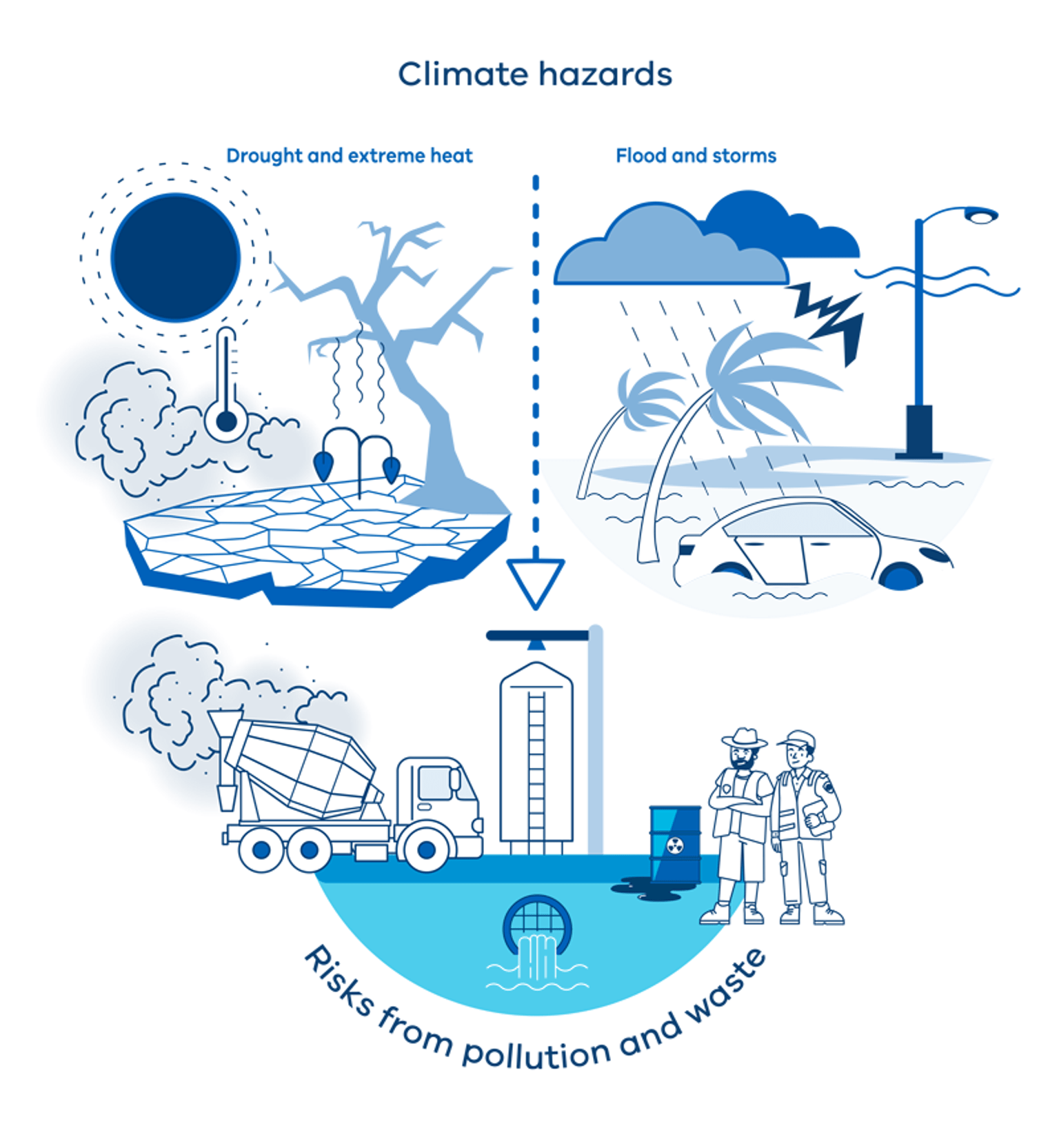
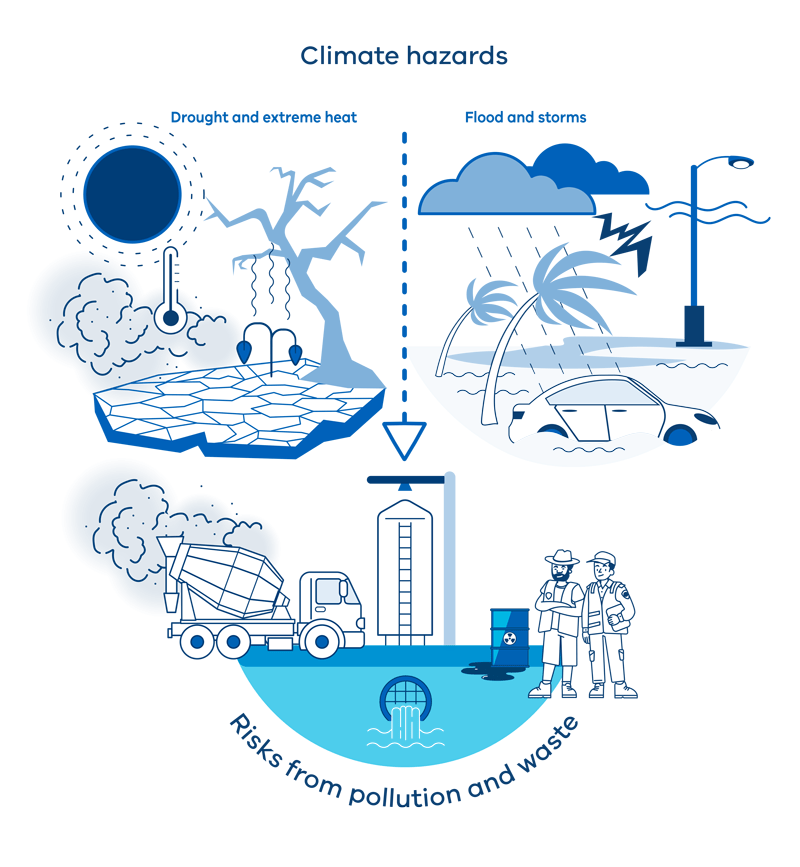
Graphic: Example of how climate hazards may cause risk of harm from a concrete batching plant.
Example 2: New chemical manufacturing plant
Mary is developing a chemical manufacturing plant in an outer south-eastern suburb of Melbourne. The design life of the plant is 30 years.
The site location meets the relevant separation distances and threshold limits in the Victorian Planning Provisions. The site is not located in a high-risk area for sea-level rise or bushfires.
Chemical works is a prescribed activity under the Environment Protection Regulations 2021. It requires a development licence from us before construction. Mary engages a consultant to assist in her development licence application. The consultant helps Mary to assess how climate change may impact the risk of harm.
Steps to control the hazards and risks
Example 3: Existing wastewater treatment plant
A regional Victorian water company provides wastewater services. It also operates several wastewater treatment plants. These are located near surface waters. The company must discharge to the environment in line with its EPA operating licences. Licence conditions relate to timing, volume and quality of discharges to surface waters. The company has RMMPs for each of their EPA licenced sites. The RMMPs document how risk of harm from pollution or waste is minimised under the GED. They include consideration of physical climate risks.
The water company recognises forward planning is critical. The water company understands:
- Victoria’s climate will continue to get warmer and drier
- more extreme weather events are expected
- the threats to wastewater storage and treatment infrastructure. These threats could increase the likelihood and consequences of surface water pollution.
The company expects wastewater volumes to increase in the future. They estimate wastewater connections in regional Victoria will increase to 3 times 2016 levels by 2065 (example only). They also recognise their sewage infrastructure will become increasingly vulnerable to climate hazards. The company understands they need to show they are minimising their physical climate risks. They need to consider this while planning for future increases in wastewater connections.
Steps to control the hazards and risks
Appendix A – How to consider climate change if your business activities are low risk
Victoria’s climate is changing. This means a warmer and drier future with more frequent and intense heatwaves, bushfires and storms.
Climate change may impact existing risks or create new risks of harm to human health or the environment from pollution and waste.
This section is for low-risk business activities such as retail stores, offices, cafes and bars. You need to look at how climate change may impact the risk of harm from your activities.
If a flood, fire, heatwave, storm or other extreme weather event hit your business, it can create pollution or waste.
What could you do different to minimise these risks from occurring
Controls to minimise pollution or waste risks in a changing climate may include:
- preparing for extreme weather events
- reviewing your procedures and training following any incident
- monitoring, maintaining and inspecting plant and equipment on a regular basis. Check for leaks which may occur more often in extreme heat and heatwaves
- inspecting and maintaining your bunding and stormwater drains. This needs to be done before and after extreme events such as heavy rainfall or flooding. Bunding should be empty and stormwater drains clean. Stormwater drains are only to be used for water
- considering options for improving storage of oils, chemicals and waste to minimise any risk of water pollution. These risks might occur more often due to heavy rainfall and flooding
- ensuring you have adequate systems and controls if things go wrong. Fire alarms and extinguishers, spill alarms, emergency procedures and spill kits are a must.