

This section of your RMMP should give an overview of the site. It should include:
- the address
- the legal entity responsible for operating the site
- key activities
- number of personnel (staff and contractors)
- site history where practicable
- EPA permissions and any other relevant information
- information on key stakeholders (see Stakeholders).
The level of detail you include in your site description is proportionate to the scale and complexity of your site and operation.
You will use this information to inform your hazard identification and risk assessment (see Risk management).
Onsite facilities and activities
Include a site plan (aerial image or diagram) that shows the layout, facilities and infrastructure onsite. Don’t limit your RMMP to your permissioned activities. It should include all activities that give rise to a potential risk of harm to human health and the environment. Features you may consider are:
- operational hours
- materials (types and volumes)
- receival and dispatch
- storage (above and below ground)
- processing
- discharges (fugitive and point sources)
- wastes
- energy sources
- pollution control equipment
- stormwater and drainage
- bunded areas
- security measures.
Environmental setting
An important step in preparing your RMMP is to develop a clear understanding of the environmental setting of your site. This will help you to identify and assess the various ways your activities can interact with and pose risks to human health and the environment.
Your surrounding environment may include social, biological and physical components such as:
- residential areas, schools, hospitals
- land use and zoning (onsite and surrounding)
- heritage sites
- traditional owner cultural values
- flora and fauna
- surface waters, including nearby creeks and other water bodies
- topography
- geology and soils
- hydrogeology and groundwater
- climate and meteorological conditions
- local airshed
- other planning overlays.
Changes to environment
To properly understand the risk context for your site and its location, you may need to consider:
- existing and changing aspects of your site and activities
- surrounding land uses and future planning considerations
- changes in zoning and overlays
- population growth and encroachment
- climate change (including whether the site and surrounding area have experienced extreme weather events).
Sensitive receptors
Some common sources of harm can impact many different aspects of the environment and human health. These are collectively referred to as ‘receptors’. Particularly sensitive receptors may include, but aren’t limited to:
- social surroundings (houses, hospitals, schools, playgrounds, public amenities)
- waterways and sources of drinking water for people or livestock
- parks and recreational areas
- areas of public interest and cultural significance
- land or water with identified plant, animal, ecosystem or environmental value.
Your RMMP should note all nearby sensitive receptors, their locations, and distances to the site. You can also mark these on your conceptual site model or a site plan, if relevant.
Conceptual site model
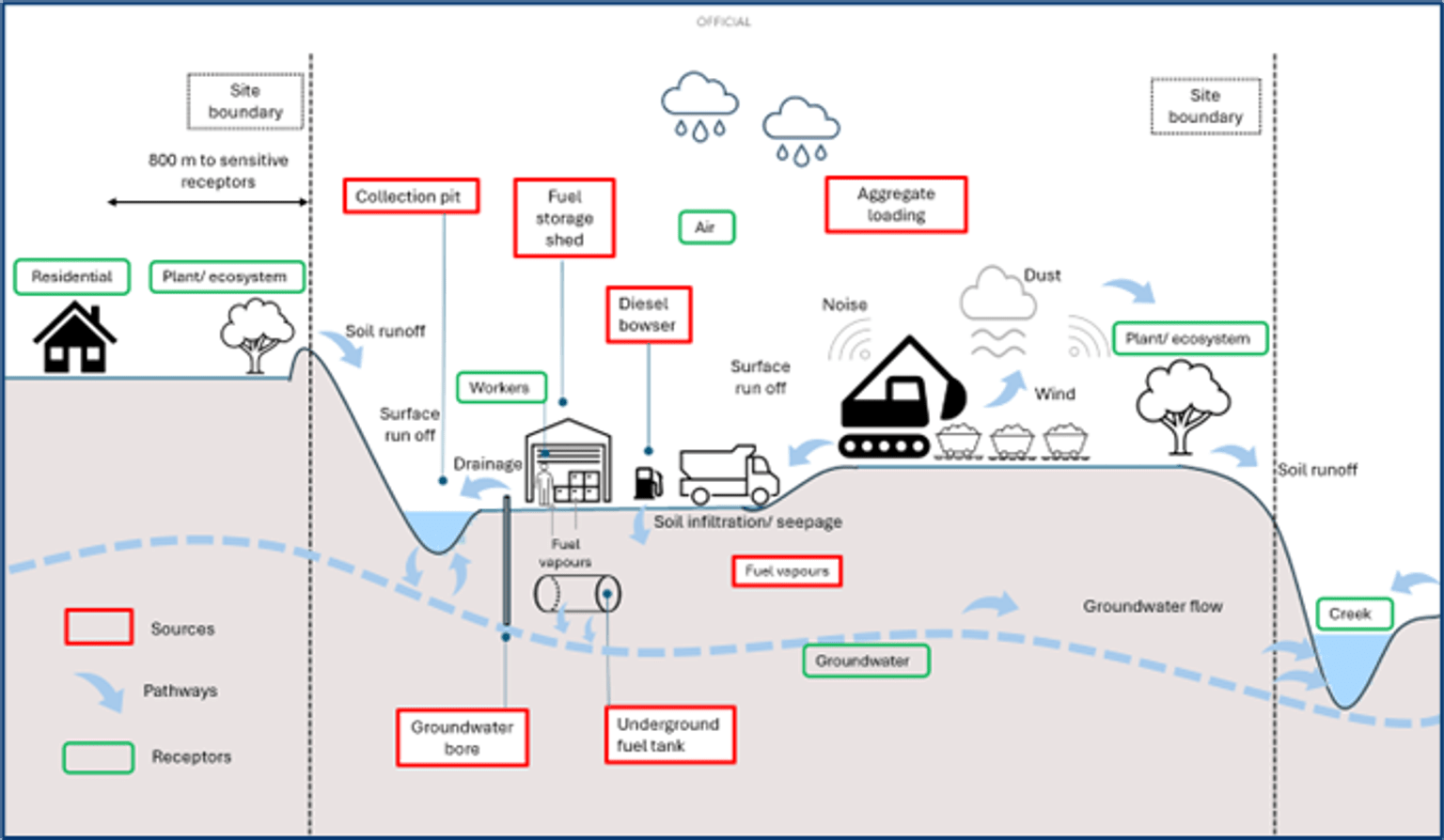
A conceptual site model (CSM) helps you to understand the human health and environmental risks posed by the site and its activities by outlining potential source, pathway and receptor relationships. You may illustrate your source-pathway-receptor linkages in this way, if appropriate.
Broadly, the CSM seeks to identify:
- site activities and hazards – sources of pollution and waste that may pose a risk to human health and the environment
- risk pathways – routes the hazard can take to reach the receptor, such as migration pathways, transport of contaminants and exposure pathways
- receptors – environmental and human receptors that can be harmed.
Risks are realised when source-pathway-receptor linkages are complete (for example, when an incident occurs that causes pollution of a waterway). To help you visualise and understand information about your site, a CSM may be presented in a text, table or pictorial format.
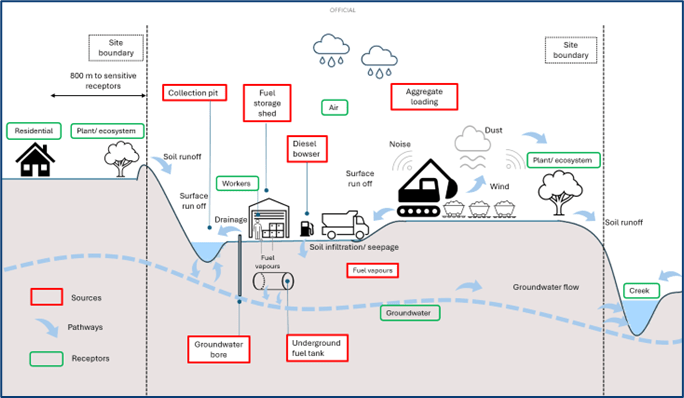
The figure below provides an example of a CSM for a concrete recycling facility presented in a pictorial format.
Conceptual site model for a concrete recycling facility
Stakeholders
Stakeholders can be internal or external interested parties. EPA expects you to have identified your stakeholders within the context of environment and human health risks and understand their expectations. It is your responsibility to ensure that potentially impacted or interested community members or stakeholders are consulted and kept informed about your site's activities and risks.
Internal interested parties
Internal interested parties can include general managers, in-house experts, section managers and, importantly, personnel conducting the activities. Risk management is the responsibility of every employee, from the managing director through to operational staff. It should be supported and driven from the top but also be informed by employee input about incidents, hazards or opportunities for improvement identified through day-to-day operations.
External interested parties
External stakeholders can include neighbours, community groups, government agencies, local government and other organisations such as energy or water utilities.
Social considerations can be more significant than you may initially expect. If your activities have the potential to generate odour, noise, dust or smoke, you may regard these impacts as part of normal operations. However, even low level or intermittent emissions may be experienced as offensive by nearby receptors, particularly where people have become sensitised through prolonged or repeated exposure. Communities may also be concerned about broader impacts in their local area such as increased traffic, vibration, visual amenity or light pollution, as well as the potential for harm to the environment itself.
For additional guidance on stakeholder engagement please refer to Engagement guidance on our website.
Updated