

- Published by:
- Environment Protection Authority
- Date:
- 17 June 2026
Purpose of this guideline
Certain permissions, including operating licences and permits, require the development of a Risk Management and Monitoring Program (RMMP) that enables the permission holder to document how they propose to minimise risks of harm to human health or the environment in accordance with the general environmental duty (GED).
This guideline assists duty holders in preparing an RMMP. It does not prescribe any risk controls or performance objectives. It describes a framework with some examples of the type of information you should include in your RMMP. Case studies and examples are for illustrative purposes only and duty holders can tailor their approach based on the size and complexity of their operations.
Risk management and monitoring programs: an overview provides an overview of preparing, implementing and reviewing your RMMP. Site Description to Training describe the type of information to include in your RMMP.
The guideline is designed for use by duty holders across all industry sectors. For this reason, a variety of examples are provided. However, the specific examples may not be suitable for all duty holders due to the range of risks that apply across different business activities.
This guideline may be updated periodically. EPA will endeavour to inform permission holders when it is revised. Refer to our website for the most recent version.
Intended audience
EPA has prepared this guideline to assist permissioned duty holders, consultants and EPA-appointed auditors to understand the expectations for developing and documenting an RMMP.
Other duty holders will also find this framework helpful when implementing a system for identifying, managing and monitoring their risks of harm to human health and the environment.
Regulatory framework
The Environment Protection Act 2017 (EP Act) includes key duties, including the GED. The GED requires that any person who is engaging in an activity that may give rise to risks of harm to human health or the environment from pollution or waste must minimise those risks, so far as reasonably practicable.
In addition, certain EPA permissions include a condition that requires you to document how you are minimising the risks from your activities in an RMMP.
Importantly, complying with an RMMP permission condition does not automatically mean that you are complying with the GED.
EPA permissions requiring an RMMP include:
- Pilot Project Licence PPL_G05
- Development Licence DL_C05
- Operating Licence OL_G05
- Permit PER_G05
- Authorisation of Discharge and Disposal ADD_G05.
If you have a pilot project or development licence, your RMMP should prepare you for your proposed activity. It may include risks that were identified during the application and development phase, including risks that are identified from commissioning activities.
Your RMMP should focus on assessing, controlling and monitoring risks from your proposed operations and activities. This may require review when you begin operations or after your operating licence has been issued, or where a change has occurred.
A well-documented RMMP that is up to date, addresses all requirements, is fully implemented and being maintained will help you demonstrate that you are meeting the conditions of your permission. It will also help to demonstrate to EPA how you intend to comply with duties under the EP Act. Implementing your RMMP will help to reduce the risks of harm to your staff, neighbours, the local environment and your business.
Below is an explanation of what EPA expects to see in your RMMP to address each element of permission condition G05/C05.
Risk management and monitoring programs: an overview
The purpose of an RMMP
As the holder of an operating licence or other permission with a G05/C05 condition, you have a legal obligation to prepare and document an RMMP.
Your RMMP is a systematic way of identifying and documenting risks to human health and the environment arising from activities at your site, and how those risks are assessed, controlled, managed and monitored.
Your RMMP should demonstrate to EPA that you have assessed and are regularly monitoring your risks and the effectiveness of your controls.
How EPA uses your RMMP
EPA uses your RMMP as a roadmap to understand what activities at your site may pose a potential risk to the environment or human health and how these risks are being minimised, controlled and monitored. For this reason, EPA expects that your RMMP is easy to follow and contains specific information and references as outlined in this guideline.
Preparing an RMMP
From Site Description to Training of this guideline describe the type of information to include in your RMMP (Part 1 of your GO5/CO5 permission condition).
To assist with meeting Part 2 of your G05/C05 permission condition, EPA expects the RMMP to be a single, consolidated document describing site activities, risks, and the controls used to manage those risks. Where controls rely on detailed monitoring, inspection, maintenance, or operational procedures, these documents should be referenced rather than included in full, with supporting documents included as appendices where practical. Extensive or frequently updated documents do not need to be appended. Referenced documents must be current and made available to EPA on request. Appendix A is an example of a checklist you may include to complete your RMMP submission.
EPA expects duty holders with multiple permissioned sites to have a separate RMMP for each of those sites. This is because risks at each site may vary depending on location, environmental setting and other factors. EPA uses this site-specific information to understand your activities, potential risks and associated controls for compliance assessments and site inspections. To ensure EPA has access to site-specific information and to avoid duplication, there is flexibility in presenting site-specific information in the main document and the common information as appendices (such as corporate standards).
A suitably experienced person, such as an environmental consultant, may assist you in preparing your RMMP. EPA’s website provides information on working with consultants.
It is important to consult with and involve your staff when preparing your RMMP. Having staff involved can provide valuable insights, practical knowledge and experience. This will help you to fully understand all your activities, the risks they pose to human health and the environment, and how those risks are to be managed. An RMMP is a living document. It should foster a sense of ownership and accountability, leading to better site management and environmental performance.
If you have a GO5/C05 condition in your permission, your RMMP must be signed by a ‘duly authorised officer’. This is a person who is accountable and authorised by your organisation to sign the document on its behalf. This authorisation is a matter for each organisation.
EPA may request a copy of your RMMP at any time. If you have a G05/C05 permission condition you must provide it on request. This means you should have an up-to-date RMMP (including supporting information) that can be provided to EPA by email, file share or other means.
Existing environmental management systems and plans
EPA acknowledges that organisations may have existing management systems or plans in place which coincide with some of the RMMP requirements described in this guideline. Those systems may be digitised and may be shared across similar sites. Examples of shared or digitised systems include:
- environmental management plans (including Waste Management Plan)
- incident reporting systems
- risk management systems
- internal auditing systems
- environmental policies and standards
- environmental performance objectives and reporting.
To avoid duplication, RMMPs may reference and link to existing documents or systems.
The RMMP is not intended to replace or duplicate your existing environmental management systems and plans. Any supporting documentation or digital systems that are embedded in your site management system may form part of your RMMP.
Your RMMP may contain a brief description of your existing systems and documents. You may provide a summary of the key information contained in those documents, with detailed references or links to fulfil RMMP requirements. These documents may include:
- plans
- process descriptions
- monitoring program reports
- data
- procedures
- human health and environmental impact assessments
- diagrams, drawings and flowcharts
- documents required as part of your licence or permission (for example, Health and environment management plan).
Implementing your RMMP
Your RMMP should accurately reflect your organisation’s operations, procedures and controls. When you have established your RMMP, your next step is to implement it.
These steps may include:
- defining roles and responsibilities so that each employee understands their part
- providing training to build awareness and competency
- establishing a system for continuous review and auditing to maintain the RMMP’s relevance and effectiveness over time (see Environmental performance).
Incorporating these elements will ensure your RMMP remains a dynamic and valuable tool for effectively managing your human health and environmental risks.
Reviewing your RMMP
EPA expects you to regularly review and update your RMMP to ensure it is current and relevant to your site activities.
Management of Change lists potential triggers for reviewing your RMMP.
You should clearly indicate the review frequency, date of the most recent review, name of the reviewer(s), and a summary of the key significant changes made based on that review.
It is important to evaluate the effectiveness of your RMMP throughout all stages of its implementation. This is part of a continuous improvement approach to managing your risks. In this way, your RMMP forms part of meeting your obligations to prevent or minimise risks under the GED.
Site description
This section of your RMMP should give an overview of the site. It should include:
- the address
- the legal entity responsible for operating the site
- key activities
- number of personnel (staff and contractors)
- site history where practicable
- EPA permissions and any other relevant information
- information on key stakeholders (see Stakeholders).
The level of detail you include in your site description is proportionate to the scale and complexity of your site and operation.
You will use this information to inform your hazard identification and risk assessment (see Risk management).
Onsite facilities and activities
Include a site plan (aerial image or diagram) that shows the layout, facilities and infrastructure onsite. Don’t limit your RMMP to your permissioned activities. It should include all activities that give rise to a potential risk of harm to human health and the environment. Features you may consider are:
- operational hours
- materials (types and volumes)
- receival and dispatch
- storage (above and below ground)
- processing
- discharges (fugitive and point sources)
- wastes
- energy sources
- pollution control equipment
- stormwater and drainage
- bunded areas
- security measures.
Environmental setting
An important step in preparing your RMMP is to develop a clear understanding of the environmental setting of your site. This will help you to identify and assess the various ways your activities can interact with and pose risks to human health and the environment.
Your surrounding environment may include social, biological and physical components such as:
- residential areas, schools, hospitals
- land use and zoning (onsite and surrounding)
- heritage sites
- traditional owner cultural values
- flora and fauna
- surface waters, including nearby creeks and other water bodies
- topography
- geology and soils
- hydrogeology and groundwater
- climate and meteorological conditions
- local airshed
- other planning overlays.
Changes to environment
To properly understand the risk context for your site and its location, you may need to consider:
- existing and changing aspects of your site and activities
- surrounding land uses and future planning considerations
- changes in zoning and overlays
- population growth and encroachment
- climate change (including whether the site and surrounding area have experienced extreme weather events).
Sensitive receptors
Some common sources of harm can impact many different aspects of the environment and human health. These are collectively referred to as ‘receptors’. Particularly sensitive receptors may include, but aren’t limited to:
- social surroundings (houses, hospitals, schools, playgrounds, public amenities)
- waterways and sources of drinking water for people or livestock
- parks and recreational areas
- areas of public interest and cultural significance
- land or water with identified plant, animal, ecosystem or environmental value.
Your RMMP should note all nearby sensitive receptors, their locations, and distances to the site. You can also mark these on your conceptual site model or a site plan, if relevant.
Conceptual site model
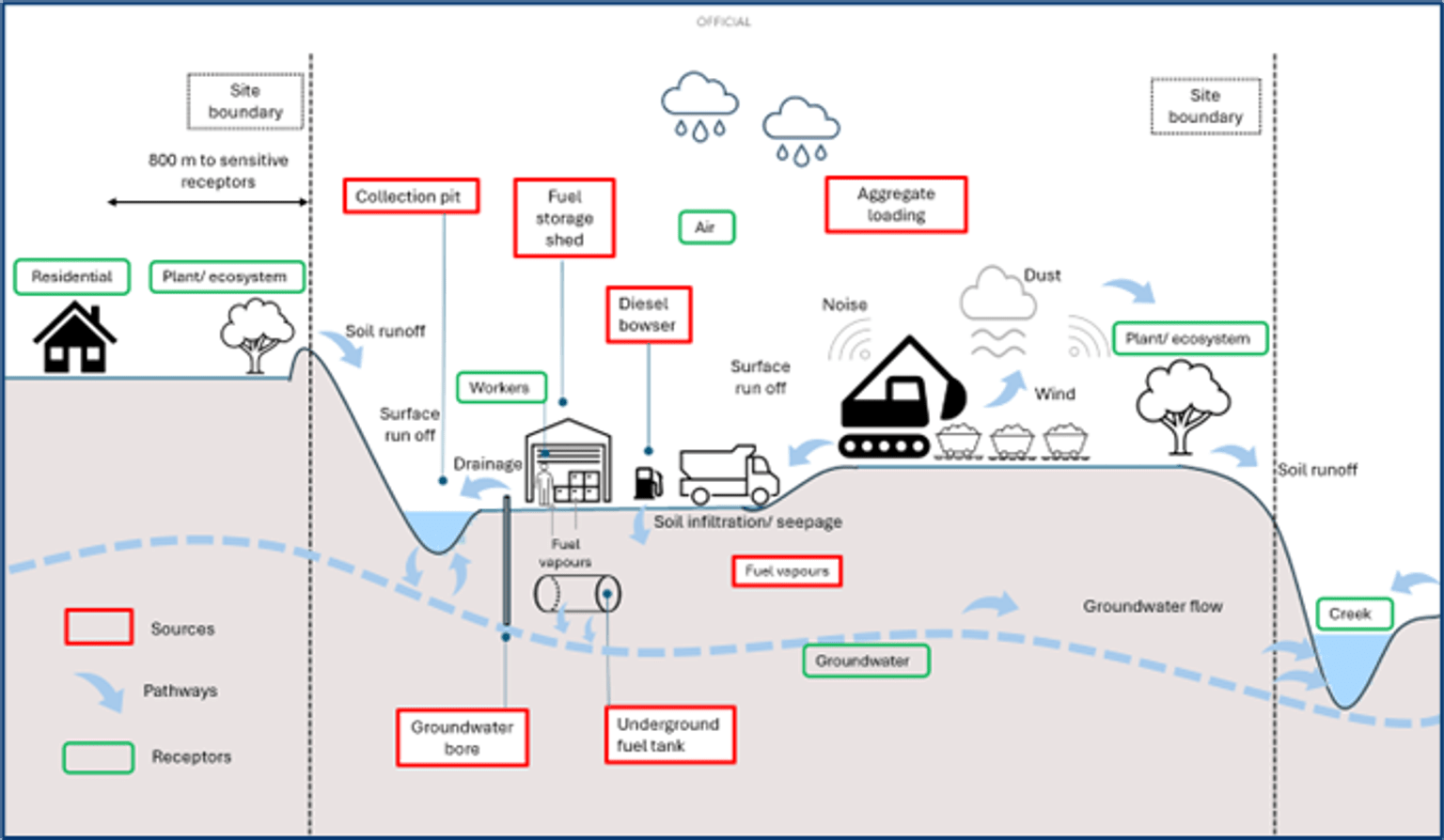
A conceptual site model (CSM) helps you to understand the human health and environmental risks posed by the site and its activities by outlining potential source, pathway and receptor relationships. You may illustrate your source-pathway-receptor linkages in this way, if appropriate.
Broadly, the CSM seeks to identify:
- site activities and hazards – sources of pollution and waste that may pose a risk to human health and the environment
- risk pathways – routes the hazard can take to reach the receptor, such as migration pathways, transport of contaminants and exposure pathways
- receptors – environmental and human receptors that can be harmed.
Risks are realised when source-pathway-receptor linkages are complete (for example, when an incident occurs that causes pollution of a waterway). To help you visualise and understand information about your site, a CSM may be presented in a text, table or pictorial format.
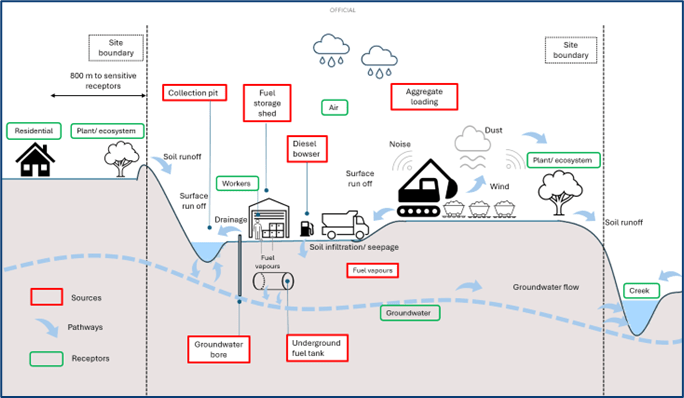
The figure below provides an example of a CSM for a concrete recycling facility presented in a pictorial format.
Conceptual site model for a concrete recycling facility
Stakeholders
Stakeholders can be internal or external interested parties. EPA expects you to have identified your stakeholders within the context of environment and human health risks and understand their expectations. It is your responsibility to ensure that potentially impacted or interested community members or stakeholders are consulted and kept informed about your site's activities and risks.
Internal interested parties
Internal interested parties can include general managers, in-house experts, section managers and, importantly, personnel conducting the activities. Risk management is the responsibility of every employee, from the managing director through to operational staff. It should be supported and driven from the top but also be informed by employee input about incidents, hazards or opportunities for improvement identified through day-to-day operations.
External interested parties
External stakeholders can include neighbours, community groups, government agencies, local government and other organisations such as energy or water utilities.
Social considerations can be more significant than you may initially expect. If your activities have the potential to generate odour, noise, dust or smoke, you may regard these impacts as part of normal operations. However, even low level or intermittent emissions may be experienced as offensive by nearby receptors, particularly where people have become sensitised through prolonged or repeated exposure. Communities may also be concerned about broader impacts in their local area such as increased traffic, vibration, visual amenity or light pollution, as well as the potential for harm to the environment itself.
For additional guidance on stakeholder engagement please refer to Engagement guidance on our website.
Risk management
It is considered best practice to apply risk management principles to your business activities. The state of knowledge around risk management is well established, with guidance, standards and information widely available. EPA recommends that you adopt an appropriate risk management framework for your business activities, proportionate to the nature and scale of the risks involved.
Assessing and controlling risk: A guide for busines (publication 1695.1) provides a structured framework to identify hazards assess risks, implement controls and monitor those controls. It aligns with the approach in AS ISO 31000:2018 Risk Management and is adaptable to businesses of all sizes. However, larger businesses or those with more complex environmental and human health risks may need to adopt suitable or more complex risk management frameworks or methods or seek professional advice. EPA has published guidelines to assist you in assessing hazards and controlling various types of environmental risks. These documents are listed in References of this guideline.
Identify hazards
Understanding your site activities, features, operational processes and environmental settings (as explained in Site description) is essential for identifying potential hazards.
Potential hazards or risk sources may include chemical or sewage spills, microbial hazards, fire, emission of pollutants, and migration of contaminants to the surrounding environment (soil, water and air). Extreme weather events can also pose significant risk. The extent of your risk assessment should be proportionate to the complexity and risks associated with your site and activities. For more examples of common hazards, see Table 2 in Assessing and controlling risk: A guide for busines (publication 1695.1).
You should identify all potential environmental and human health hazards associated with your site activities and features and record them in your risk register (see Risk register). You may refer to your CSM, if you have one, to assist with identifying hazards.
The next step is to assess how these hazards might affect the environment and human health, which will form the basis of your risk assessment.
Assess risks
Risk assessment is a fundamental component of your RMMP. It uses information from the hazards you have identified to determine which site activities require some form of control to minimise their potential human health and environmental impacts.
Your risk assessment may also identify your compliance obligations. For example, those arising from your EPA licence conditions, the EP Act and subordinate legislation.
Your risk assessment must cover the risks of harm to the environment and human health. These harms may be cumulative and could be a result of multiple occurrences of harm arising from the same activity or the effects of harm from various activities. Different risks can interact, intensifying their overall impact. For example, combined effects of noise, dust and odour from a landfill may significantly affect community wellbeing and local amenity.
By understanding how multiple risks combine or escalate, you can assess whether existing controls remain sufficient and take timely action to prevent harm.
Risk assessment method
You need to perform a risk assessment for each identified environmental and human health hazard. Use an appropriate risk assessment method to accurately and adequately assess your risks. If appropriate, you may follow the risk assessment method outlined in pages 8 – 10 of in Assessing and controlling risk: A guide for busines (publication 1695.1). Depending on the scale and complexity of your site, you may use different methods.
Your RMMP should clearly set out your chosen risk assessment method. It should describe the criteria for assessing the likelihood and consequence of risks to human health and the environment. It should also explain the rationale or justification behind selecting the criteria.
Your risk assessment should also include a risk matrix and a description of risk ratings. For example: What does a ‘high’ or ‘medium’ rating mean? Are existing controls sufficient or are more controls needed? This can be incorporated as a dedicated section in the main body of the document or in the risk register spreadsheet, with the detailed procedure as an appendix.
The entire risk assessment process should be documented, and those documents should be maintained to provide a basis for your implemented controls. They will also enable regular checking of controls or reassessment of risks.
Detailed risk assessment and supporting documents
Where relevant, your RMMP may be supported by detailed risk assessments for key environmental aspects associated with your site. For example:
- human health risk assessment
- fire risk assessment
- ecological risk assessment
- soil and groundwater risk assessment
- emerging contaminant risk assessment
- climate change risk assessment.
The RMMP should reference the reports for any risk assessments conducted for your site and provide a summary of the key findings and actions detailed in these reports.
Risk register
Your RMMP should include a complete up-to-date risk register (also known as an ‘aspects and impacts’ register). This is a critical component of an RMMP.
Risk registers are commonly presented in a tabular format, such as a table or spreadsheet. EPA recommends that you include the following key columns and associated information:
- activities/features
- location/area of site
- hazards/risk sources
- causes of hazards/risks
- environmental impacts and consequences
- environmental segment/receptor (for example, wetlands, waterways, and residential areas)
- inherent risk level/rating
- existing controls/control measures
- critical controls (Describe critical controls)
- residual risk level/rating
- future controls/action or improvement plans.
You may also wish to include:
- risk event
- how controls are monitored (see Check controls and Monitoring)
- control effectiveness
- control maintenance information
- control references/procedures
- control checks/verification
- references to management plans
- compliance requirements
- action plan implementation/target dates
- risk owners
- references to other risk studies/assessments
- date of last review of risk assessment.
See Appendix B for an example risk register.
EPA may ask you to provide further information or details on any of the above, for example:
- evidence of control effectiveness
- evidence that your controls are reasonably practicable
- details of your risk action plan
- control improvement or upgrade plans
- links to trigger action plans.
Implement controls
Controls are essential for both minimising your risks so far as reasonably practicable and achieving your environmental performance objectives. This is why it is important to establish, implement and maintain your controls.
Reasonably practicable (publication 1856) explains, with examples, all the key factors and criteria that need to be considered in determining reasonably practicable risk controls.
Identify controls
As outlined in publication 1695.1, the options for controlling risk should be prioritised from the highest level of effectiveness to the lowest:
- Elimination (remove the hazard entirely)
- Substitution (replace hazardous materials or processes with safer alternatives) / Engineering controls (install plant, processes and equipment to reduce risk)
- Administrative controls (implement policies, procedures, and training to reduce risk) and personal protective equipment (provide protective gear to workers).
These controls can be used individually or in combination using the hierarchy of the options (from 1 to 3).
The type and number of controls in your risk register will depend on the nature of your activities, the level of risk, opportunities, environmental aspects and compliance obligations.
Ideally, controls should be developed and maintained by suitably experienced people (these may include consultants) with input from employees and managers who will be responsible for implementing them.
Describe critical controls
Controls are considered critical when their absence or failure could lead to severe incidents that will impact human health and the environment. You should highlight your critical controls in your risk register. For example, a local exhaust ventilation (LEV) system is a critical control. This is an engineering control that reduces exposure to airborne contaminants such as dust, mist, fumes, vapour and gas. It works by capturing emissions at their source and transporting them to a safe emission point or a filter/scrubber.
In your RMMP, you should clearly describe your critical controls for activities with high inherent risk ratings. This description should cover their purpose, functionality, maintenance and monitoring for effectiveness. You are encouraged to describe the processes for identifying, responding to and reviewing failures of critical controls to ensure their ongoing effectiveness.
The level of detail when describing critical controls should reflect:
- the complexity of the activities
- the potential severity of the environmental impact it is preventing or minimising.
Check controls
Your RMMP should also document how you check your controls.
Ensuring the functionality and effectiveness of controls is crucial. Regular checks and monitoring help to verify that controls are functioning as intended and are reducing risks of potential harm to human health and the environment. See also Risk control performance objectives.
The frequency of control checks and reviews is typically determined by the level of risk associated with the activity or emission being managed. Critical controls may require more frequent verification and performance monitoring. For further details see Evaluating environmental performance.
Management of change
You should regularly review your risk assessment and risk register to ensure that hazards remain relevant and control measures and risk management strategies continue to be effective and fit for purpose.
Several factors may also trigger a review including, but not limited to:
- changes in legislation or other sources of new compliance requirements
- changes to your activities, equipment or processes
- incidents or near misses
- inefficiencies or failures in existing controls
- organisational changes – for example, mergers, acquisitions, decommissioning, or internal restructuring
- emerging risks or changes in the operational environment
- extreme weather and climate change or variability
- availability of new technologies and state of knowledge
- periodic evaluations of performance
- concerns or recommendations from key stakeholders
- risk register reviews.
Changes should be documented and managed to ensure that they do not compromise existing risk management controls or introduce a new risk that itself requires control.
Environmental performance
Environmental performance is the ongoing process of assessment and improvement to continuously reduce (eliminate or minimise) your organisation’s risks of harm to human health and the environment. In assessing and reporting on your environmental performance, you need to consider:
- your obligations under the EP Act and Regulations (for example, GED)
- the conditions of your permission
- the environmental values listed in the Environment Reference Standard
- your organisation’s environmental policy
- environmental performance objectives and indicators
- risk control performance objectives
- industry or activity standards
- the implementation of an environmental management system framework (for example, AS/NZS ISO 14001:2016)
- your risk assessment
- past environmental performance
- any past incidents.
It is important to verify whether you are achieving your environmental performance targets. This typically involves collecting and analysing data and using metrics to track your progress against environmental objectives and measures.
Environmental performance objectives
Environmental performance objectives specify the goals that you set to eliminate or minimise identified risks from your activities. They define your desired outcomes for environmental performance and compliance. The objectives may reflect the commitments in your organisation’s environmental policy, if it has one.
Environmental performance objectives can focus on reducing key environmental risks related to your activities (such as risks to air or water quality) or a particular pollutant that is high risk They can be business-wide or site-specific and should be developed with input from your stakeholders.
To demonstrate continual improvement, environmental performance objectives should be meaningful and measurable. Where reasonably practicable they may go beyond base-level performance against statutory and licence requirements. They may also vary depending on the relevant timeframes they are assessed against.
Environmental performance indicators
Each environmental performance objective should have one or more associated performance indicators. These indicators track progress towards achieving your objectives. They need to be specific, measurable, achievable, relevant and time-bound (SMART). Monitoring these indicators helps you to understand whether you need to make any improvements or changes to your operations, environmental performance objectives or risk management processes.
Environmental performance indicators are different to licence limits. Licence conditions set an upper limit for emissions or discharges that you must not exceed. Complying with licence conditions does not necessarily mean you are minimising risks or improving your performance. Any additional measures you can take to reduce emissions or discharges should be included in your environmental performance objectives and reflected in your environmental performance indicators. This is one way to demonstrate how you apply the GED principles in practice.
Your environmental performance objectives and indicators should be clearly defined in your RMMP. For example, the information may be presented as a table or in dot points. Some examples of environmental performance objectives and associated indicators are below.
Examples of environmental performance objectives and associated indicators
Case study 1a
Risk control performance objectives
Setting risk control performance objectives provides a benchmark to assess how effectively your controls are working. They assist in identifying whether an implemented control:
- is functioning as intended; and
- is effective; or
- requires any corrective action.
Risk control performance objectives should be defined for your critical controls. Risk control performance objectives may be based on industry standards and codes. It is important that the key requirements you set for your risk control performance objectives are specific, measurable, achievable, relevant and time-bound (SMART).
The number of risk control performance objectives needed may depend on the complexity of your operations. For a site with simple operations, it may be possible to monitor the performance for all control measures. For a more complex site it may be more practical to group the risk control performance objectives. For example, you may group your risk control performance objectives according to key operational areas of your site or segments of the environment. Importantly, this should be done in a way that is meaningful for your organisation and for EPA.
You set risk control performance objectives with the intent of achieving your environmental performance objectives. Monitoring risk control performance objectives helps you understand how you are progressing toward your environmental performance objectives.
EPA expects you to clearly define your risk control performance objectives in your RMMP and demonstrate how they support your environmental performance objectives. Risk control performance objectives related to engineering or operational controls may be documented in your maintenance framework (for example, maintenance or asset management plans).
Example risk control performance objectives and indicators
Case study 1b
Monitoring
Once environmental performance objectives and indicators, and risk control performance objectives have been set, it is important to routinely check whether your controls are performing to your established standards and meeting your targets.
The necessary data or observations to demonstrate this will be collected through implementation of an environmental monitoring program that specifies the frequency, location and type of checks required.
Operational controls and environmental monitoring
The type of monitoring you conduct depends on the specific risks posed by your activity. It may include:
- groundwater, surface water or stormwater sampling
- stack testing
- continuous emissions monitoring (CEM)
- dust monitoring
- odour checks
- noise, leachate or landfill gas monitoring
- any other type of monitoring such as event-based or periodic (daily, weekly, etc.)
- continuous real-time monitoring linked to a SCADA system (for example, water level or discharge monitoring).
Other data gathered as part of your routine checks may include:
- maintenance records
- consultant reports, site inspections, walk-throughs or other regular checks
- incident records and near misses
- complaints, community reports or any other type of feedback from affected communities and stakeholders
- assessment of pollution incidents
- benchmarking of performance during the development licence phase
- correspondence with external parties, for example, WorkSafe, EPA, local council.
You (or your consultants) should analyse the data and results from your monitoring program to identify any trends, patterns, noncompliance and areas for improvement. The quality of your data should also be checked to ensure they are representative of your activities. Your quality control checks might include:
- instrument calibration
- instrument maintenance and performance checks
- competence of personnel conducting the monitoring
- consistency of results obtained by different operators
- investigation of outlier results
- changes to equipment at the monitoring point.
EPA expects your monitoring activities to be linked to your risk control performance objectives and be relevant to your environmental performance objectives. Details of your monitoring program must be included in your RMMP.
Refer to Appendix C for an example of a monitoring plan and how it can be linked to performance objectives.
Trigger action response
As part of your monitoring (particularly where you are monitoring any segment of the environment as defined in the Environment Reference Standard), your RMMP should include specific actions for when pre-defined conditions (‘triggers’) are met. This includes actions to:
- compare environmental monitoring data with guideline value or objective
- immediately respond when a trigger is exceeded
- escalate measures to manage the situation that has been triggered.
Depending on risk and complexity, it may be appropriate that triggers are established using a tiered approach to allow staged levels of response, for example:
- Tier 1 (green, alert trigger) for early indication of potential impact or an emerging issue
- Tier 2 (amber, action trigger) for indication of potential impact or moderate risk
- Tier 3 (red, impact trigger) for realised impact or unacceptable risk.
For simple monitoring procedures, a tiered approach may not be necessary.
Your RMMP should clearly illustrate your trigger action response in a summary table that is easy for EPA to find and review. This may be attached as an appendix to your RMMP or provided as listed references so that EPA may access it.
Examples of the trigger action response approach
This example may apply for the monitoring of groundwater quality associated with the risk of leakage from an industrial wastewater lagoon.
Further detail about trigger action responses and additional examples of how this information can be presented is provided in Appendix D.
Evaluating environmental performance
Evaluating environmental performance is important. It allows you to measure and assess the effectiveness of your controls. The results of your evaluation can present a wide range of opportunities, including:
- demonstrating your controls are in accordance with the GED
- demonstrating compliance with other regulatory controls and permission conditions
- assessing the effectiveness of your selected risk controls
- identifying opportunities for resource efficiency
- identifying opportunities for waste reduction
- confirming the suitability of your environmental performance indicators
- establishing performance benchmarks to compare future performance against
- identifying opportunities for improvements in training
- assessing the long-term impacts of environmental incidents and the corrective actions taken.
A combination of monitoring, auditing and reviewing your environmental performance is necessary to ensure the ongoing effectiveness of your environmental controls and to drive continuous improvement, in accordance with the GED.
Internal auditing
Audits of your environmental performance are systematic assessments of your organisation’s operations, activities and processes. The frequency of these audits should be set by an audit schedule. They may be performed internally or by an independent consultant who specialises in these types of audits. This is part of meeting your C05/G05 permission condition.
Internal audits identify:
- the effectiveness of your organisation’s environmental management practices and processes
- the degree of compliance with environmental laws and regulations, and industry standards
- how your environmental performance aligns with your environmental commitments (for example, organisation policies, environmental objectives)
- any new and potential environmental risks
- areas where additional training is required
- areas for improvement, and recommendations for minimising your organisation’s environmental risks.
EPA expects your RMMP to include an environmental performance audit plan. This plan should describe how you will measure the effectiveness of your monitoring activities, controls and procedures.
Review and continuous improvement
In addition to monitoring and conducting audits, it is best practice to formally review your overall environmental performance. This review can assess whether your environmental procedures and objectives remain adequate.
The review should aim to identify any potential gaps in your environmental performance, and opportunities for improvement. The purpose of the review is to ensure your existing critical controls are up to date with current information and available technology. What constitutes a reasonably practicable risk control changes over time as new knowledge emerges and new techniques and technologies are developed. Your review may also be influenced by any factors that have triggered a review of your risk assessment, as described in Management of change.
Environmental performance reviews can be conducted in various ways. A typical review team includes management, environmental advisors, site personnel and technical specialists where needed. Each time you complete a review, it is suggested that you include different site personnel. Their perspective might generate ideas for improvement that have not been identified before. Involvement of senior management demonstrates a commitment to environmental performance internally and to EPA.
Monitoring, auditing, and reviewing is necessary as they form the basis for driving continual improvement. The ultimate objective of continual improvement is to eliminate the risks of harm to human health and the environment so far as reasonably practicable.
EPA expects your RMMP to include a description of your environmental performance review approach. Your approach should outline how information from your risk assessment, environmental performance objectives, monitoring and audits is used to evaluate and improve your environmental performance.
Incident and emergency management
Incident and emergency management are key requirements under:
- Section 25 of the EP Act: the GED
- Section 31 of the EP Act: the duty to take action to respond to harm by a pollution incident
- in some cases, permission conditions.
It is important to include environmental emergency and incident management plans and procedures in your RMMP as they are key controls for minimising risks.
Incident management
An environmental incident is a departure from standard operating conditions that can or does have an impact on human health or the environment. Examples of environmental incidents may include:
- an emergency
- pollution and notifiable incidents (Part 3.4 of the EP Act)
- an event that poses a threat to human health or the environment (which does not necessarily trigger Part 3.4 of the EP Act)
- noncompliance with a permission condition
- noncompliance with an environmental performance indicator
- a complaint received regarding an environmental issue
- a failure of pollution controls.
Your RMMP should include a description of your environmental incident management procedure and supporting systems and how these are used to inform any reviews and prevent recurrence.
This environmental incident management procedure should identify:
- the purpose and scope of the procedure
- responsibilities
- criteria for incidents, including the distinction between an incident, notifiable incident and emergency
- types of incidents and management of those incidents
- notification requirements (including, but not necessarily limited to, notifying EPA)
- incident investigation
- corrective actions
- record management.
It is common practice to describe how you use the lessons learned from incidents, near misses and emergencies to review your risk register. These can provide valuable insight into unforeseen risks or failure of controls. EPA expects your RMMP reviews (see Reviewing your RMMP) to be informed by your incident records and past performance.
The description in your RMMP should also include a list of the types of events that would be considered an environmental incident at your site.
These should be consistent with your risk register (see Risk register).
Emergency management
An emergency is an unplanned event or accident that causes or threatens to cause severe harm to human health, property or the environment. An emergency requires immediate action to reduce its impact and escalation. Emergency events might involve fire, flood, a hazardous spill (for example, from tank or pipe failure), vehicle impact or sabotage.
As part of your RMMP, EPA expects you to have an emergency management plan in place, which ensures that if a risk of harm to human health or the environment from pollution or waste did occur, its harmful effects would be minimised.
Emergency management plans typically include:
- a description of the types of emergencies that may occur, as identified through your risk assessments
- methods for mitigating the environmental impacts
- communications and reporting requirements to EPA
- training of emergency response personnel
- post-emergency actions.
Your emergency management plan should be described in your RMMP and may be included as an attachment or reference.
For guidance on developing an emergency management plan, see part 6 of Management and storage of combustible and waste materials (Publication 1677).
Reporting incidents and emergencies
You should have a documented procedure for the reporting of incidents, emergencies and near misses.
The reporting process should include:
- details of the incident
- the response to the incident
- outcomes of any remedial actions taken
- investigations into the cause of the incident
- actions taken to prevent recurrence.
EPA expects your incident reporting procedure to identify internal and external reporting requirements, such as those imposed by your permission conditions and Part 3.4 of the EP Act – Duties relating to pollution incidents.
The procedure should describe the types of incidents that may be reportable to EPA. For example, mercury exceedances from a stack, uncontained spills and discharges, or unplanned operational upsets causing significant dust or odour with impacts beyond the site boundary.
Training
As a business, you must ensure that appropriate information, instruction, supervision and training is provided to any person engaging in an activity for your business that may give rise to risks of harm to human health or the environment. This is important for demonstrating that all persons are acting in accordance with the GED. In many cases training forms part of your organisation’s risk controls and for this reason EPA expects you to include training as part of your RMMP.
The training can range from one-on-one demonstrations to formal presentations with competency checks. Depending on the role and the capability of the person in that role, it is good practice to provide regular refresher training to ensure an adequate level of competency is maintained.
You are expected to identify roles, responsibilities, competencies and training (around your critical controls) to help manage your risks. This may be documented in a training matrix. EPA recommends that you also keep a register of the training provided to your personnel. This will enable you to track the training that has been provided and the skills each person has attained from that training. You may be asked at any time to make this information available to EPA.
You may provide a summary of how you conduct your training needs analysis, and the outcome of this analysis, in your RMMP as presented in the table below.
Example of a training/skills matrix for a clinical waste treatment plant (autoclave)
| Competencies/training requirements | Refresher frequency | Operators | Weighbridge operators | Drivers | Operations manager | Environment manager |
| Environmental site induction (including waste material risks) | Annually | Yes | Yes | Yes | Yes | Yes |
| Standard Operating Procedure (SOP) waste acceptance (including waste codes, EPA licence requirements) | Every 2 years | Yes | Yes | Yes | Yes | Yes |
| SOP spill responses | Every 2 years | Yes | Yes | Yes | Yes | Yes |
| SOP waste bin tipping | As part of induction | Yes | Yes | Yes | ||
| SOP autoclave operation control | As part of induction | Yes | Yes | |||
| Site inspection/ housekeeping checklist (including drain cleaning) | Every 2 years | Yes | Yes | Yes | Yes | |
| Risk assessment procedure | Every 2 years | Yes | Yes | |||
| Implementation of RMMP | Every 2 years and as reviewed | Yes | Yes | |||
| Emergency procedures | Every 2 years | Yes | Yes | Yes | Yes | Yes |
| Water sampling procedures | N/A | Yes |
References and other useful resources
EP Act 2017 / Legislative references
Environmental Laws and Regulations
Supporting you to comply with the general environmental duty (Publication 1741.1)
Risk management
Assessing and controlling risk: A guide for business (Publication 1695.1 )
Performance objectives
NOPSEMA – Control measures and performance standards (under Scope of validation for a proposed facility)
WorkSafe – Guidance notes, performance standards and indicators
Reasonably practicable
Reasonably practicable (Publication 1856)
Miscellaneous
Preparing a decommissioning plan
Pre-application engagement guidance
Compliance and enforcement policy (Publication 1798)
Guideline for assessing and minimising air pollution (Publication 1961)
Minimise greenhouse gas emissions from your business (Publication 2048)
Minimising pollution and waste risks in a changing climate
Management and storage of combustible recyclable and waste materials (Publication 1667.3)
Urban stormwater management guidelines (Publication 1739)
Biofilter design and maintenance (Publication 1880)
Guidance for field odour surveillance (Publication 1881)
Guidance for assessing odour (Publication 1883)
Guidance for assessing nuisance dust (Publication 1943)
Operating organic waste processing facilities (Publication 1588)
Guideline for onsite wastewater management
Victorian guidelines for water recycling (Publication 1910)
Liquid storage and handling guidelines (Publication 1698)
Solid storage and handling guidelines (Publication 1730)
Managing soil disturbance (Publication 1894)
Landfill licensing (Publication 1323.3)
Biofilter design and maintenance (Publication 1880)
Background levels methodology guidance (Publication 2033)
IChEMS – Industrial chemicals environmental management standard